
Esophageal Pressure Manometry (Pes)
Coming 2027 @ Big Basin Way in Historic Downtown Saratoga (California)
Esophageal pressure manometry, often called a Pes study, is the most precise way to measure the effort it takes you to breathe while you sleep. At Sleep and Brain, we add Pes to select polysomnograms to definitively diagnose Upper Airway Resistance Syndrome (UARS), a subtle form of sleep-disordered breathing that standard sleep studies routinely miss.
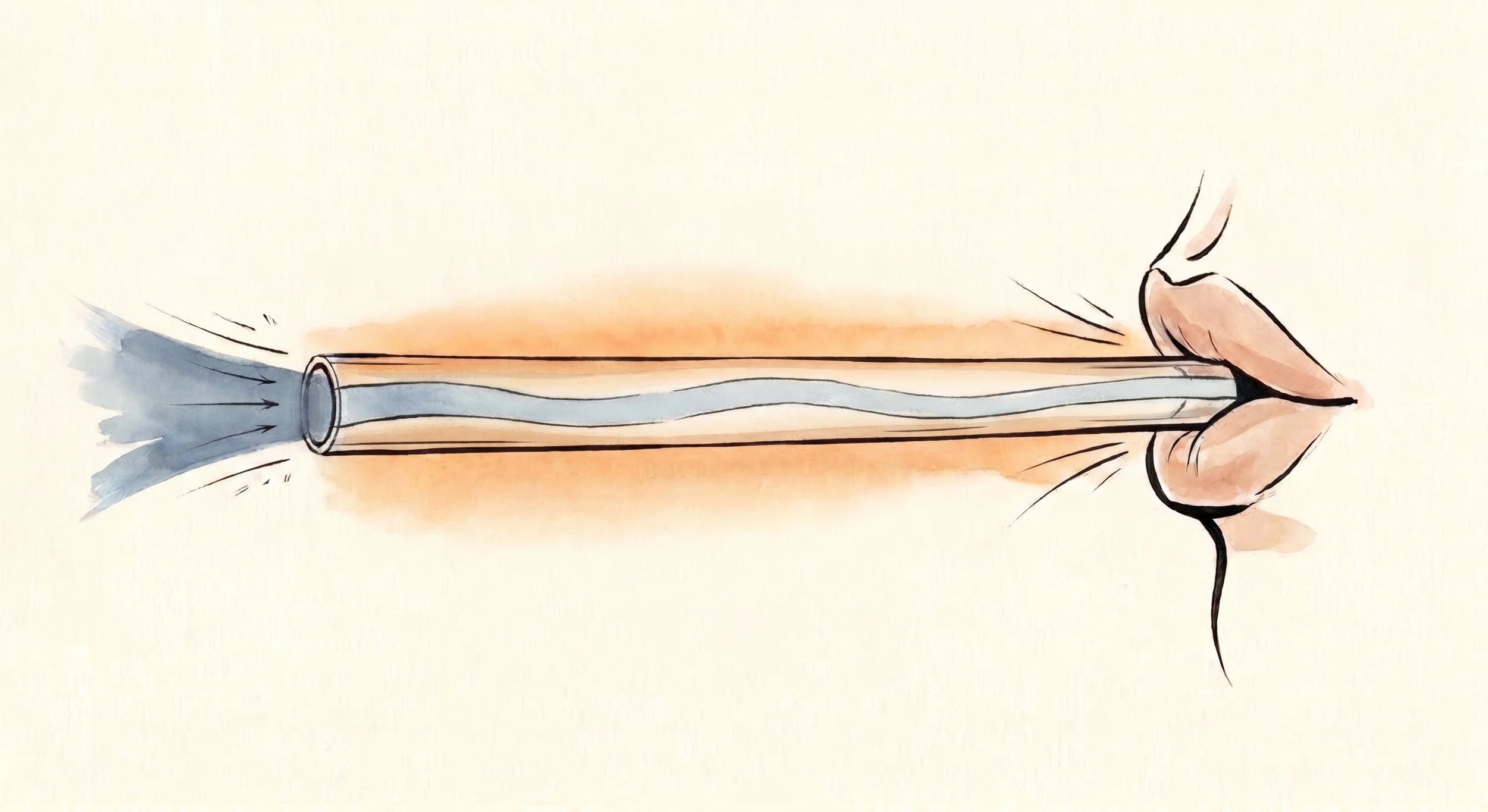
Most sleep tests, including a standard laboratory or home polysomnogram, estimate airflow using a nasal cannula and belts around the chest and abdomen. These sensors are excellent at detecting complete or partial airway collapse that defines obstructive sleep apnea. However, they are far less sensitive to a subtler pattern: a narrowed airway that never fully collapses, yet forces the brain to work harder and harder to pull air past the obstruction, arousing you from deep sleep long before your oxygen levels ever drop.
A standard Apnea-Hypopnea Index (AHI) can look entirely normal in this scenario; individuals with UARS are frequently told their sleep study is "normal" despite significant, unrefreshing sleep, daytime fatigue, and cognitive fog.
Esophageal pressure manometry closes this gap. Directly measuring the pressure swings in your chest with each breath captures the escalating respiratory effort that precedes an arousal, an effort that a nasal cannula and belts alone cannot reliably detect. This is the same technique pioneered in the original research that first described UARS, and it remains the diagnostic reference standard for confirming the condition.
How It Works
Because catheter placement and signal quality are critical to an accurate result, a Pes study is always performed as an attended, in-person overnight study; our clinical team remains present throughout the night rather than applying sensors and leaving, as with our standard home polysomnogram.
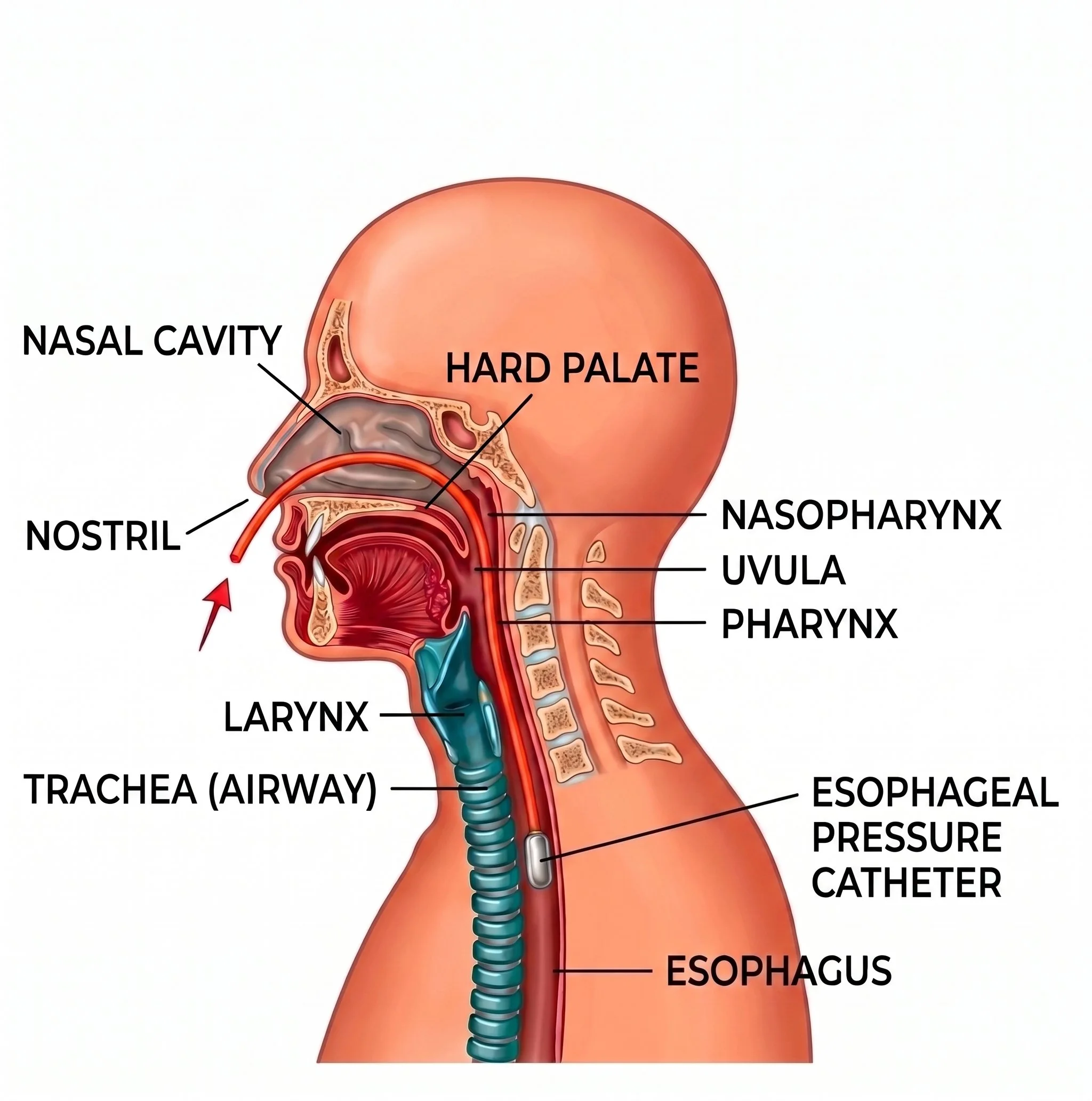
Once you arrive, a soft, thin, flexible pressure-sensing catheter is passed gently through one nostril and positioned in the lower esophagus. The catheter is no thicker than a strand of spaghetti. Our technician verifies the correct placement and signal quality before your night of recorded sleep begins and remains on-site throughout the study to monitor the catheter, address any discomfort or displacement, and ensure that the full night of data is usable. The catheter continuously records the pressure changes generated by your breathing effort, alongside the standard brain wave, airflow, oxygen, and movement data collected during any polysomnogram.
Not all esophageal pressure catheters are equal. Most labs still use older fluid-filled ("balloon") catheters; Sleep and Brain uses a solid-state microtransducer catheter, which measures pressure differently and more reliably:
Fluid-Filled ("Balloon") Catheters
Signal augmentation (overshoot, resonance) can distort the true pressure reading.
A slight time delay between the actual pressure change and what's recorded
Motion artifact ("catheter whip") from patient movement during the night
Reading can shift depending on the catheter's position/height, since it's measuring through a column of fluid.
Larger diameter, since the sensor sits inside an inflated balloon at the tip, which can mean more discomfort during placement
Solid-State Catheter
A true, direct pressure signal at the sensor tip, with no fluid column involved
No measurable time delay
No motion artifact
Reading stays accurate regardless of your position or movement.
Roughly half the diameter of a standard balloon catheter (about 1.2 mm at the tip), for a more comfortable placement
This is a meaningful difference in both comfort and data reliability.
Before your recorded sleep begins, our technician performs a brief validation step, sometimes called an occlusion or "Baydur" maneuver in the pulmonary literature. You're asked to make a few gentle inspiratory efforts against a momentarily closed airway while pressure is compared between your mouth and the esophageal catheter. A close match between the two confirms the catheter is correctly positioned in the esophagus, not the stomach, and well-coupled to capture true respiratory effort throughout the night. This calibration step is a standard part of ensuring your study produces reliable, interpretable data.
Published sleep-medicine research describes esophageal pressure manometry as a safe, generally well-tolerated procedure with minimal impact on overall sleep architecture. Most patients settle into a normal night's sleep once the catheter is positioned and calibrated.
Understanding Your Results: Normal vs. Abnormal Pressures
Esophageal pressure is measured in centimeters of water (cmH₂O), the same unit used for CPAP pressure settings. Because inhaling requires generating negative pressure to draw air into the lungs, normal Pes readings are negative numbers, and the more negative the number, the harder the body is working to breathe. What matters most for diagnosis is not any single number in isolation, but the pattern of change from breath to breath.
Normal, quiet breathing during sleep: roughly -2 to -8 cmH₂O, with effort remaining stable across breaths.
Flow limitation and UARS (Respiratory Effort-Related Arousals): a crescendo pattern,pressure grows progressively more negative over a sequence of breaths, often reaching -10 to -25 cmH₂O or more, as the airway narrows and the body works harder to maintain airflow, until the effort triggers a brief arousal from sleep and the pressure abruptly returns toward normal. Per American Academy of Sleep Medicine scoring criteria, it is this pattern, not a single fixed pressure value, that defines a Respiratory Effort-Related Arousal, per Wellman et al. (Journal of Applied Physiology, 2014) and Sands et al. (Sleep, 2018), since the exact pressure that triggers an arousal varies considerably from person to person.
Obstructive apnea or hypopnea: effort increases further still as the airway becomes partially or fully blocked, with Pes swings commonly reported in the -20 to -80 cmH₂O range or more in published research, reflecting intense, often escalating inspiratory effort against a mechanically obstructed airway.
Central apnea or hypopnea: Pes remains near baseline, with little to no negative deflection (roughly 0 to -2 cmH₂O), because the brain has temporarily stopped signaling the breathing muscles to work, despite the absence or reduction of airflow.
Pes data is included in the Respiratory Disturbance Index (RDI) rather than an Apnea-Hypopnea Index (AHI). RDI combines your AHI with your RERA index, the rate of Pes-confirmed respiratory effort arousals, into a single measure of total sleep-disordered breathing. This is the number that most directly reflects the burden of UARS, and it is often meaningfully higher than the AHI alone in patients whose conventional study appeared normal.
This effort-versus-no-effort distinction is precisely what a nasal cannula and respiratory belts alone cannot reliably capture, and why Pes remains the reference standard for telling an obstructive event from a central one, and for confirming UARS when standard testing looks normal. Because chest wall compliance, body composition, and individual arousal thresholds vary considerably between people, your physician interprets your Pes findings in the full context of your study, brain wave activity, airflow, oxygen levels, and your reported symptoms, rather than any single value on its own.
Why We Offer This
At Sleep and Brain, we built our diagnostic program around measuring what conventional sleep labs don't measure: brain activity, nasal airflow resistance, oral and respiratory muscle function, and now the true effort behind every breath. UARS is one of the most commonly under-recognized causes of unrefreshing sleep, and confirming it changes everything about how a case should be treated, from the appliances and therapies we recommend to how we counsel you on outcomes. We consider Pes an essential tool for the patients who need it, not a routine add-on for everyone.
Pes Uses
Normal Study, Persistent Symptoms
A prior home or laboratory sleep study came back normal or near-normal, despite ongoing symptoms of unrefreshing sleep, fatigue, or insomnia.
Clinical Suspicion of UARS
Strong clinical suspicion of UARS based on history, anatomy, or prior test results (such as rhinomanometry or oral/respiratory muscle strength findings)
Treatment-Resistant Symptoms
Limited or absent improvement with CPAP, an oral appliance, or other prior sleep-disordered breathing treatment
Need for Objective Confirmation
A need for precise, objective confirmation of UARS before pursuing further treatment
Frequently asked questions
-
Most people notice mild nasal or throat discomfort during placement, similar to sensations reported with a nasogastric or feeding tube, which typically eases within a few minutes. The catheter is thin and flexible, and the vast majority of patients are able to fall asleep normally once it is positioned.
-
Yes, for the appropriate patient. It is a well-established technique with a long track record in sleep medicine research and clinical practice. As with any nasal catheter, it is not appropriate for everyone; people with certain nasal, esophageal, or bleeding conditions may not be candidates, and our physician will screen for this before your study.
-
A standard nasal cannula and respiratory belts estimate airflow and effort indirectly, from the outside. Esophageal pressure manometry measures the actual pressure generated inside your chest with every breath, making it far more sensitive to the subtle, escalating breathing effort that defines UARS but does not always register as a classic apnea or hypopnea.
-
Yes. Pes is recorded alongside, not instead of, the full polysomnogram. You will receive a complete report covering brain activity, breathing, oxygen levels, and movement, along with the additional esophageal pressure data and its interpretation.
-
If you have already completed a sleep study with us or another provider and your symptoms don't align with the results, ask our clinical team whether Pes is appropriate for you. It is not necessary for most patients, but it can be the deciding factor for those whose fatigue and unrefreshing sleep remain unexplained.
