
Transcranial Photobiomodulation

Fire! When you hold your hand near a fire, you feel its warmth. What's happening? The warmth you feel comes from the fire's infrared radiation, which your skin absorbs, stimulating your nerves to sense heat. Similarly, brain stimulation via transcranial photobiomodulation stimulates neuronal mitochondria, increasing cellular energy levels. This process modulates neuronal communication and brain waves by promoting neural synchronization and activity in targeted frequency ranges.
Alpha brainwaves represent the brain's resting state and are most prominent when your mind is meditative. These waves foster mental coordination, calmness, and inner peace. Alpha photobiomodulation can elevate neural alpha wave activity, enhancing relaxation and mental balance. In contrast, gamma brainwaves dominate when your mind is focused, attentive, and engaged in learning. They represent the brain's active state, where elevated gamma oscillations are associated with increased mental acuity and cognitive performance. Gamma photobiomodulation can boost neural gamma wave activity, supporting sharper focus and improved learning capabilities.
This isn't a novel or unstudied idea, pulsed near-infrared stimulation at specific frequencies has been shown in peer-reviewed human EEG research to produce measurable, frequency-specific brainwave changes, including work published in Scientific Reports (Nature) and ongoing research from multiple university bioengineering labs.
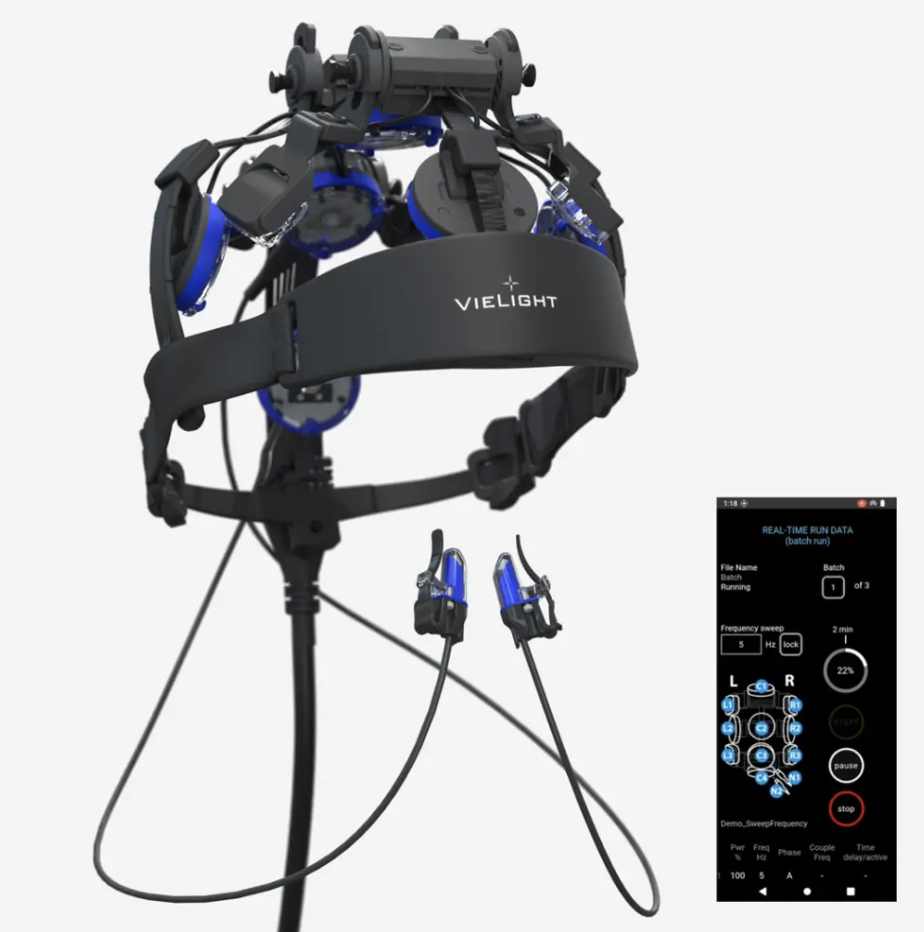
At Sleep and Brain, we address the challenges of delivering near-infrared light energy (810–1100 nm) to the brain by overcoming obstacles like hair, scalp, and tissue. We use wavelengths within the body's optical window (800–1100 nm), which penetrate human tissue effectively. Among these, we focus on 810 nm, a wavelength with the lowest absorbance by tissue, blood, and water, making it ideal for brain stimulation. The 810 nm wavelength penetrates deeply, targeting mitochondria to boost adenosine triphosphate production, reduce oxidative stress, and regulate reactive oxygen species, enhancing cellular function. It also promotes neurogenesis, supporting the formation of new cortical neurons, while its anti-inflammatory properties are being studied for their potential to reduce neuroinflammation and support brain healing.

To ensure maximum energy delivery, we position the LEDs directly with the scalp, minimizing distance and preventing energy loss caused by the inverse square law of light. We also use advanced LED lens technology to bypass hair, which can be a significant barrier by trapping and absorbing light. By combining the optimal wavelength, direct LED-to-scalp contact, and hair-bypassing technology, we ensure effective and precise delivery of near-infrared red energy into the brain.
Achieving the optimal irradiance level is essential to ensure effective brain photobiomodulation. We use up to 400 mW/cm² of irradiance, the concentration of light energy delivered at the surface. Sufficient irradiance is critical for near-infrared light to penetrate the skin and skull. Photobiomodulation research has consistently shown a dose-response relationship rather than a simple "more is better" one — too little light under-stimulates tissue, but too much can be counterproductive. Our irradiance levels are set within the range used in published human tPBM research to stay in the effective window. Our system's irradiance ensures the light energy reaches the intended regions effectively, enabling superior outcomes for brain health while remaining within safe limits.
In addition to scalp sites, Sleep and Brain uses intranasal photobiomodulation to deliver near-infrared energy through the nose, targeting the brain's underside. This method directly stimulates the olfactory bulb, which connects to brain regions responsible for long-term memory storage and reaches the ventromedial prefrontal cortex, a key area for cognition.
Photobiomodulation is generally very well-tolerated. The most common experience during a session is mild warmth or a gentle scalp sensation, most people find it relaxing. A few things we screen for before starting:
Photosensitizing medications: certain antibiotics, retinoids, and some psychiatric medications can increase light sensitivity.
Photosensitivity conditions: conditions such as lupus or porphyria may warrant extra caution.
Eye protection: given the light intensities involved, protective eyewear is used during sessions, particularly with modules positioned near the eyes or with the intranasal applicator.
We'll review your medical history during your consultation to confirm you're a good candidate.
A typical session lasts approximately 20 minutes, and most patients complete a course of 6 sessions per week over eight weeks, though this is tailored to your individual protocol and goals. Sessions are relaxing and require no downtime — you can resume normal activities immediately afterward.
At Sleep and Brain, we avoid using transcranial photobiomodulation helmets. Helmets fail to address hair as a barrier, with their inflexible dome shape causing significant energy loss through absorption by hair. They are also rigid and cannot adapt to different head sizes and shapes, increasing the distance between the light source and the scalp, which leads to rapid energy loss due to the inverse square law of light. Furthermore, helmets often rely on numerous weak LEDs, which generate high total power but insufficient irradiance, leaving the light energy too weak to penetrate the scalp effectively. Finally, helmets lack proper ventilation, leading to heat buildup, discomfort, and reduced practicality.
Sleep and Brain tailors photobiomodulation to optimize brain connectivity to ensure balanced neural network enhancement for cognitive and emotional well-being. We provide targeted neural stimulation by focusing on specific brain networks or comprehensive neural stimulation by engaging all networks simultaneously. In addition to standard alpha and gamma protocols, we utilize advanced features like cross-frequency coupling, frequency sweeps, and neural network synchronization.
We utilize the Gracefire protocols, developed through years of neurofeedback research, along with adjustable module positioning for precise targeting. We customize session parameters, including session length, power intensity, phase asynchrony, duty cycle, and frequency pulses ranging from 1 to 40 Hz. We activate modules in various combinations, including synchronized patterns, enabling personalized programs that meet diverse cognitive and neurological needs. This customization level is designed to support optimized outcomes for brain health.
Photobiomodulation devices, including the technology used here, are categorized by the FDA as low-risk general wellness devices. They are not FDA-cleared or approved to diagnose, treat, cure, or prevent any specific disease or condition. We offer this as part of a broader, individualized approach to brain health.
Frequently asked questions
-
Di Gregorio E, Staelens M, Hosseinkhah N, Karimpoor M, Liburd J, Lim L, Shankar K, Tuszyński JA. Raman Spectroscopy Reveals Photobiomodulation-Induced α-Helix to β-Sheet Transition in Tubulins: Potential Implications for Alzheimer's and Other Neurodegenerative Diseases. Nanomaterials (Basel). 2024 Jun 26;14(13):1093. doi: 10.3390/nano14131093. PMID: 38998698; PMCID: PMC11243591.
Lim L. Modifying Alzheimer's disease pathophysiology with photobiomodulation: model, evidence, and future with EEG-guided intervention. Front Neurol. 2024 Aug 23;15:1407785. doi: 10.3389/fneur.2024.1407785. PMID: 39246604; PMCID: PMC11377238.
Chao LL. Effects of Home Photobiomodulation Treatments on Cognitive and Behavioral Function, Cerebral Perfusion, and Resting-State Functional Connectivity in Patients with Dementia: A Pilot Trial. Photobiomodul Photomed Laser Surg. 2019 Mar;37(3):133-141. doi: 10.1089/photob.2018.4555. Epub 2019 Feb 13. PMID: 31050950.
-
Saltmarche AE, Naeser MA, Ho KF, Hamblin MR, Lim L. Significant Improvement in Cognition in Mild to Moderately Severe Dementia Cases Treated with Transcranial Plus Intranasal Photobiomodulation: Case Series Report. Photomed Laser Surg. 2017 Aug;35(8):432-441. doi: 10.1089/pho.2016.4227. Epub 2017 Feb 10. PMID: 28186867; PMCID: PMC5568598.
Holmes E, Barrett DW, Saucedo CL, O'Connor P, Liu H, Gonzalez-Lima F. Cognitive Enhancement by Transcranial Photobiomodulation Is Associated With Cerebrovascular Oxygenation of the Prefrontal Cortex. Front Neurosci. 2019 Oct 18;13:1129. doi: 10.3389/fnins.2019.01129. PMID: 31680847; PMCID: PMC6813459.
Gonzalez-Lima F, Barrett DW. Augmentation of cognitive brain functions with transcranial lasers. Front Syst Neurosci. 2014 Mar 14;8:36. doi: 10.3389/fnsys.2014.00036. PMID: 24672439; PMCID: PMC3953713.
-
Johnson PK, Fino PC, Wilde EA, Hovenden ES, Russell HA, Velez C, Pelo R, Morris AJ, Kreter N, Read EN, Keleher F, Esopenko C, Lindsey HM, Newsome MR, Thayn D, McCabe C, Mullen CM, Davidson LE, Liebel SW, Carr L, Tate DF. The Effect of Intranasal Plus Transcranial Photobiomodulation on Neuromuscular Control in Individuals with Repetitive Head Acceleration Events. Photobiomodul Photomed Laser Surg. 2024 Jun;42(6):404-413. doi: 10.1089/pho.2023.0178. Epub 2024 Jun 7. PMID: 38848287; PMCID: PMC11587703.
Naeser MA, Martin PI, Ho MD, Krengel MH, Bogdanova Y, Knight JA, Hamblin MR, Fedoruk AE, Poole LG, Cheng C, Koo B. Transcranial Photobiomodulation Treatment: Significant Improvements in Four Ex-Football Players with Possible Chronic Traumatic Encephalopathy. J Alzheimers Dis Rep. 2023 Jan 31;7(1):77-105. doi: 10.3233/ADR-220022. PMID: 36777329; PMCID: PMC9912826.
S W Liebel, P K Johnson, H M Lindsey, H A Russell, E S Hovenden, C Velez, L S Carr, E A Wilde, D F Tate, A-25 Transcranial Photobiomodulation Treatment Effects In Former Athletes With Repetitive Head Hits, Archives of Clinical Neuropsychology, Volume 37, Issue 5, August 2022, Page 1066, https://doi.org/10.1093/arclin/acac32.25
Chao LL, Barlow C, Karimpoor M, Lim L. Changes in Brain Function and Structure After Self-Administered Home Photobiomodulation Treatment in a Concussion Case. Front Neurol. 2020 Sep 8;11:952. doi: 10.3389/fneur.2020.00952. PMID: 33013635; PMCID: PMC7509409.
Lim L. Traumatic Brain Injury Recovery with Photobiomodulation: Cellular Mechanisms, Clinical Evidence, and Future Potential. Cells. 2024 Feb 23;13(5):385. doi: 10.3390/cells13050385. PMID: 38474349; PMCID: PMC10931349.
Figueiro Longo MG, Tan CO, Chan ST, Welt J, Avesta A, Ratai E, Mercaldo ND, Yendiki A, Namati J, Chico-Calero I, Parry BA, Drake L, Anderson R, Rauch T, Diaz-Arrastia R, Lev M, Lee J, Hamblin M, Vakoc B, Gupta R. Effect of Transcranial Low-Level Light Therapy vs Sham Therapy Among Patients With Moderate Traumatic Brain Injury: A Randomized Clinical Trial. JAMA Netw Open. 2020 Sep 1;3(9):e2017337. doi: 10.1001/jamanetworkopen.2020.17337. PMID: 32926117; PMCID: PMC7490644.
Naeser MA, Ho MD, Martin PI, Hamblin MR, Koo BB. Increased Functional Connectivity Within Intrinsic Neural Networks in Chronic Stroke Following Treatment with Red/Near-Infrared Transcranial Photobiomodulation: Case Series with Improved Naming in Aphasia. Photobiomodul Photomed Laser Surg. 2020 Feb;38(2):115-131. doi: 10.1089/photob.2019.4630. Epub 2019 Oct 17. PMID: 31621498.
Naeser MA, Saltmarche A, Krengel MH, Hamblin MR, Knight JA. Improved cognitive function after transcranial, light-emitting diode treatments in chronic, traumatic brain injury: two case reports. Photomed Laser Surg. 2011 May;29(5):351-8. doi: 10.1089/pho.2010.2814. Epub 2010 Dec 23. PMID: 21182447; PMCID: PMC3104287.
-
Liebert A, Bicknell B, Laakso EL, Heller G, Jalilitabaei P, Tilley S, Mitrofanis J, Kiat H. Improvements in clinical signs of Parkinson's disease using photobiomodulation: a prospective proof-of-concept study. BMC Neurol. 2021 Jul 2;21(1):256. doi: 10.1186/s12883-021-02248-y. PMID: 34215216; PMCID: PMC8249215.
Foo ASC, Soong TW, Yeo TT, Lim KL. Mitochondrial Dysfunction and Parkinson's Disease-Near-Infrared Photobiomodulation as a Potential Therapeutic Strategy. Front Aging Neurosci. 2020 Apr 3;12:89. doi: 10.3389/fnagi.2020.00089. PMID: 32308618; PMCID: PMC7145956.
-
Chao LL. Improvements in Gulf War Illness Symptoms After Near-Infrared Transcranial and Intranasal Photobiomodulation: Two Case Reports. Mil Med. 2019 Oct 1;184(9-10):e568-e574. doi: 10.1093/milmed/usz037. PMID: 30916762.
Peña, J., Muthalib, M., Beaty, R. E., Sampedro, A., Ibarretxe-Bilbao, N., Zubiaurre-Elorza, L., … Ojeda, N. (2023). Enhancement of Divergent Creative Thinking After Transcranial Near-Infrared Photobiomodulation Over the Default Mode Network. Creativity Research Journal, 36(1), 1–14. https://doi.org/10.1080/10400419.2023.2219953.
Schiffer F, Johnston AL, Ravichandran C, Polcari A, Teicher MH, Webb RH, Hamblin MR. Psychological benefits 2 and 4 weeks after a single treatment with near infrared light to the forehead: a pilot study of 10 patients with major depression and anxiety. Behav Brain Funct. 2009 Dec 8;5:46. doi: 10.1186/1744-9081-5-46. PMID: 19995444; PMCID: PMC2796659.
Askalsky P, Iosifescu DV. Transcranial Photobiomodulation For The Management Of Depression: Current Perspectives. Neuropsychiatr Dis Treat. 2019 Nov 22;15:3255-3272. doi: 10.2147/NDT.S188906. PMID: 31819453; PMCID: PMC6878920.
Cassano P, Petrie SR, Hamblin MR, Henderson TA, Iosifescu DV. Review of transcranial photobiomodulation for major depressive disorder: targeting brain metabolism, inflammation, oxidative stress, and neurogenesis. Neurophotonics. 2016 Jul;3(3):031404. doi: 10.1117/1.NPh.3.3.031404. Epub 2016 Mar 4. PMID: 26989758; PMCID: PMC4777909.
-
Pallanti S, Di Ponzio M, Grassi E, Vannini G, Cauli G. Transcranial Photobiomodulation for the Treatment of Children with Autism Spectrum Disorder (ASD): A Retrospective Study. Children (Basel). 2022 May 20;9(5):755. doi: 10.3390/children9050755. PMID: 35626932; PMCID: PMC9139753.
-
Lim L, Hosseinkhah N, Van Buskirk M, Berk A, Loheswaran G, Abbaspour Z, Karimpoor M, Smith A, Ho KF, Pushparaj A, Zahavi M, White A, Rubine J, Zidel B, Henderson C, Clayton RG, Tingley DR, Miller DJ, Karimpoor M, Hamblin MR. Photobiomodulation Treatment with a Home-Use Device for COVID-19: A Randomized Controlled Trial for Efficacy and Safety. Photobiomodul Photomed Laser Surg. 2024 Jun;42(6):393-403. doi: 10.1089/pho.2023.0179. Epub 2024 Jun 19. PMID: 38940733.
-
Yuan Y, Cassano P, Pias M, Fang Q. Transcranial photobiomodulation with near-infrared light from childhood to elderliness: simulation of dosimetry. Neurophotonics. 2020 Jan;7(1):015009. doi: 10.1117/1.NPh.7.1.015009. Epub 2020 Feb 24. PMID: 32118086; PMCID: PMC7039173.
Pitzschke A, Lovisa B, Seydoux O, Zellweger M, Pfleiderer M, Tardy Y, Wagnières G. Red and NIR light dosimetry in the human deep brain. Phys Med Biol. 2015 Apr 7;60(7):2921-37. doi: 10.1088/0031-9155/60/7/2921. Epub 2015 Mar 19. PMID: 25789711.
Yue L, Humayun MS. Monte Carlo analysis of the enhanced transcranial penetration using distributed near-infrared emitter array. J Biomed Opt. 2015 Aug;20(8):88001. doi: 10.1117/1.JBO.20.8.088001. PMID: 26252627.
Jagdeo JR, Adams LE, Brody NI, Siegel DM. Transcranial red and near infrared light transmission in a cadaveric model. PLoS One. 2012;7(10):e47460. doi: 10.1371/journal.pone.0047460. Epub 2012 Oct 15. PMID: 23077622; PMCID: PMC3471828.
-
Wong-Riley MT, Liang HL, Eells JT, Chance B, Henry MM, Buchmann E, Kane M, Whelan HT. Photobiomodulation directly benefits primary neurons functionally inactivated by toxins: role of cytochrome c oxidase. J Biol Chem. 2005 Feb 11;280(6):4761-71. doi: 10.1074/jbc.M409650200. Epub 2004 Nov 22. PMID: 15557336.
Liebert AD, Chow RT, Bicknell BT, Varigos E. Neuroprotective Effects Against POCD by Photobiomodulation: Evidence from Assembly/Disassembly of the Cytoskeleton. J Exp Neurosci. 2016 Feb 1;10:1-19. doi: 10.4137/JEN.S33444. PMID: 26848276; PMCID: PMC4737522.
Jou MJ, Jou SB, Guo MJ, Wu HY, Peng TI. Mitochondrial reactive oxygen species generation and calcium increase induced by visible light in astrocytes. Ann N Y Acad Sci. 2004 Apr;1011:45-56. doi: 10.1007/978-3-662-41088-2_5. PMID: 15126282.
Salehpour F, Mahmoudi J, Kamari F, Sadigh-Eteghad S, Rasta SH, Hamblin MR. Brain Photobiomodulation Therapy: a Narrative Review. Mol Neurobiol. 2018 Aug;55(8):6601-6636. doi: 10.1007/s12035-017-0852-4. Epub 2018 Jan 11. PMID: 29327206; PMCID: PMC6041198.
Moro C, Massri NE, Torres N, Ratel D, De Jaeger X, Chabrol C, Perraut F, Bourgerette A, Berger M, Purushothuman S, Johnstone D, Stone J, Mitrofanis J, Benabid AL. Photobiomodulation inside the brain: a novel method of applying near-infrared light intracranially and its impact on dopaminergic cell survival in MPTP-treated mice. J Neurosurg. 2014 Mar;120(3):670-83. doi: 10.3171/2013.9.JNS13423. Epub 2013 Oct 25. PMID: 24160475.
-
Generally, healthy individuals should be able to use the device safely by limiting its use to 20 minutes.
Children can use this, but we start with 5-10 minutes and gradually extend; if headaches occur, reduce the duration.We recommend checking with your child's pediatrician before starting, since pediatric use of these devices is offered as a general wellness practice rather than a clinically validated, dosage-tested protocol for children specifically.
You can share a unit with your partner but we recommend cleaning the nasal applicator with alcohol between uses, or you can purchase a separate applicator if preferred.
There have been no reported incidences of intranasal devices interfering with pacemakers. This is consistent with how the device works, it uses light, not electromagnetic fields, so there's no known mechanism for pacemaker interference the way there is with devices like TMS. Still, we recommend patients with a pacemaker or other implanted cardiac device mention it during their consultation as routine practice.
Vielight technology is FDA registered under the Medical Specialty of Physical Medicine and is supported by our audited FDA QS820-compliant quality system. The FDA has also categorized the devices as low-risk general wellness devices by its draft "General Wellness: Policy on Low-Risk Devices," dated January 20, 2015 under its "General Wellness: Policy for Low Risk Devices" guidance. first issued as a draft on January 20, 2015, and since finalized and most recently reissued in January 2026. All Vielight devices have been independently TÜV certified as safe for consumer use.
One clarifying note worth adding nearby, since "FDA registered" is easy to misread: FDA registration means the device manufacturer is registered as an establishment with the FDA, it is not the same as FDA clearance or approval of a specific therapeutic claim. The devices remain classified as general wellness products, not as treatments for any diagnosed condition.
-
This varies on an individual basis. Some users have reported changes within a week. We guide users to complete an 8 week trial. However, some have taken much longer to notice improvements in their general wellness.
